Nobody wants to hear that the equipment has been shipped off to a manufacturer for a six-week diagnostic. Especially when a screen goes black in a busy bar on a Friday night, or a scoreboard fails ten minutes before throw-in, That’s the reality for most Irish venues relying on standard AV support models.
In-house AV repairs flip that equation completely, keeping fault resolution under one roof and getting systems back online in hours rather than weeks.
Below, we unpack exactly how the in-house model works, what it costs venues when repairs are outsourced, and where the real savings show up on your balance sheet.
How Does In-House AV Repair Actually Work?
In-house AV repair means the company that supplied and installed your equipment also employs the technicians who fix it. The workflow is straightforward. A fault is reported, a technician runs remote diagnostics where possible, and if hardware intervention is needed, someone is dispatched with the right parts.
- Remote system monitoring flags issues before the client even notices.
- Familiarity with the exact install means faster fault isolation.
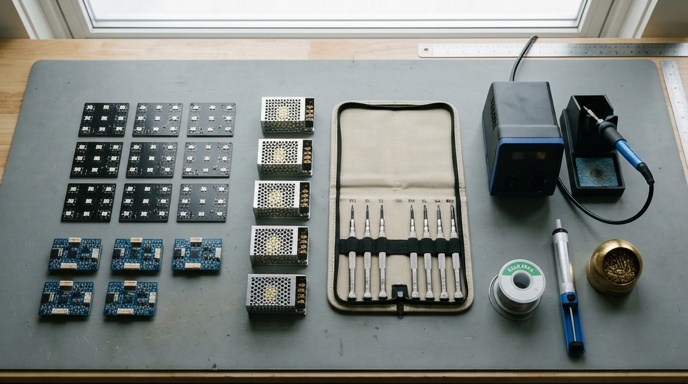
- Common spares (LED modules, receiving cards, PSUs, driver ICs) are held locally.
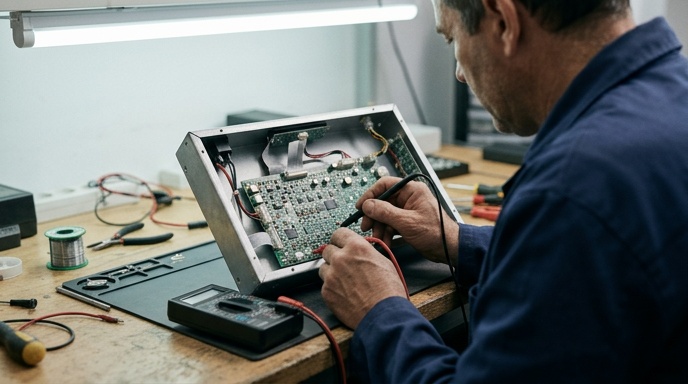
- Board-level and component-level repairs are handled directly, not swapped out.
Compare that to the standard outsourced model. You log a ticket, wait for a call-back, courier the unit to a third party or back to the manufacturer, wait for a diagnosis, wait for a quote, approve it, then wait for the return leg. That’s weeks of dead time on a system you paid good money for.
What Does AV Failure Really Cost Your Venue?
Downtime costs far more than the repair itself. For a hospitality venue, entertainment space or retail store, a dark screen or silent PA translates directly into lost bookings, weaker customer experience and, in sports venues, an unusable event. The true cost sits in revenue, reputation and replacement rentals.
Direct Revenue Loss
A nightclub with a broken audio rig doesn’t open. A restaurant with a failed digital menu board loses upsell opportunities on every table. A GAA scoreboard failure on match day can force organisers to run a manual system, which looks unprofessional to sponsors paying for pitchside visibility.
Emergency Rental Fees
When permanent kit fails and repairs drag on, venues often rent replacement equipment to cover the gap. Short-notice LED screen or PA hire is expensive, and the cost quickly outstrips what a fast in-house repair would have run.
Reputation And Repeat Custom
Guests remember a bad experience. A concert with distorted audio, a wedding with a frozen video wall, or a match with a broken scoreboard damages the venue’s brand long after the fault is fixed.
According to guidance from the Competition and Consumer Protection Commission, service reliability is a core factor in consumer trust, and AV is a visible part of that experience.
How In-House Repairs Save a Lot?
The savings from in-house repair fall into four buckets. Faster fixes, lower parts costs, no courier or logistics fees, and longer equipment lifespan through proper maintenance rather than blanket replacement.
- Turnaround time drops from weeks to hours or days for most common faults.
- Parts costs are lower because component-level repair beats full-unit swap-outs.
- No shipping fees for sending gear to overseas service centres.
- Longer equipment life because faults are caught early and fixed properly.
There’s also a softer saving that adds up over years. When the team fixing your kit is the same team that designed and installed it, they spot patterns. A recurring PSU failure across similar installs leads to a proactive upgrade recommendation, not another repair invoice. That kind of institutional knowledge only exists when the repair function stays in-house.
Why Third-Party Repair Chains Slow You Down
Third-party repair chains introduce delays at every stage. The equipment moves through multiple hands, each with its own queue, paperwork and priorities. Even under warranty, the process can stretch to months, and during that time your venue is running on reduced capability or paying for temporary replacements.
The Warranty Return Trap
Manufacturer warranties sound reassuring until you actually need one. Return authorisations, freight forwarding, customs clearance for kit going outside the EU, and back-and-forth on diagnostics can add weeks. That’s fine if the unit is a spare, but not if it’s your main video wall.
The Communication Gap
When your installer isn’t your repairer, information gets lost. The repair depot doesn’t know your rack layout, your signal chain or your last firmware update. You end up acting as the middleman, relaying details you shouldn’t need to know.
A single point of accountability changes everything. If you’d like to see how integrated support looks in practice, our permanent installation services are backed by the same in-house technical team from day one, and our rental division operates on the same principle for event kit.
Which Venues Benefit Most From In-House Repair Support?
Any venue where AV downtime directly hits revenue or reputation benefits from an in-house repair model. That covers hospitality, retail, sports facilities, entertainment venues and any operation running digital signage or live event systems on a daily basis.
- Hospitality groups running multi-site AV across bars, restaurants and hotels.
- Retail chains using digital signage for promotional content and wayfinding.
- Sports venues relying on scoreboards, pitchside LED and PA for match days.
- Nightclubs and live venues where audio, lighting and video must perform every night.
- Corporate and education environments with critical presentation and lecture theatre kit.
For businesses under health and safety obligations, reliable venue systems also feed into emergency communications and PA. The Health and Safety Authority outlines general requirements for workplace communication systems, and a properly maintained AV setup supports compliance rather than complicating it.
What To Ask Before You Sign An AV Contract
Before committing to any AV supplier, get clear answers on who fixes the kit when it breaks. The contract terms around repair, response times and parts availability tell you more about long-term value than the headline install price.
- Do you employ your own repair technicians, or do you outsource?
- What’s your typical turnaround on common LED, audio and control faults?
- Do you stock spares locally, or wait for shipments from overseas?
- What response time do you guarantee for contracted clients?
- Can you offer remote monitoring to catch faults before they escalate?
- Is there a 24/7 emergency line for critical failures?
If the answers are vague, or the supplier deflects to a manufacturer warranty, that’s your signal. The best AV partners treat repair as a core part of the service, not an afterthought bolted on at contract stage. To discuss a project or a support arrangement for existing kit, get in touch through our contact page and the team will come back within 24 hours.
Making The Right Call For Your Venue
The AV industry has spent years selling installations and treating repair as someone else’s problem. That model works fine until something breaks. Then the true cost of a fragmented service chain becomes painfully clear, and it’s always the venue owner who pays it.
If uptime matters to your business, ask any prospective AV supplier one straight question before you sign. Who fixes it when it fails? If the answer isn’t their own team, keep looking. That is where you might need a trusted AV company with solid past work.
AVL is one of the reliable AV specialists in Ireland, catering to every audio, video, and lighting need. Whether you want to rent or buy, we are just one call away. Contact us anytime, tell us your requirements, and let us explain to you the best equipment for your venue.