Planning an awards ceremony sounds glamorous until you’re three weeks out, the seating plan has changed twice, and nobody can agree on whether the winners’ names should appear on the big screen or be read from a card. The truth is that perfect awards ceremony ideas needs a few practical decisions made early, not a last-minute scramble the week of the event.
Below is a working guide based on how we prep and deliver awards nights across the country, from GAA club presentations in the local hall to corporate galas in Dublin ballrooms.
Tip 1: Start With the Format, Not the Frills
Before anyone talks about a red carpet or a magician for the drinks reception, decide what kind of night you’re actually running. Awards ceremonies in Ireland tend to fall into three broad formats, and the format drives every other decision.
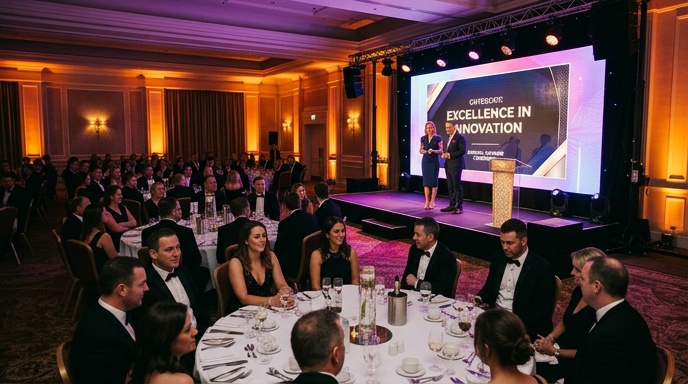
- Seated dinner and awards. Guests are at round tables, the awards run between courses, and the night finishes with music or a band.
- Standing reception with a stage segment. Drinks, canapes, a 30 to 40 minute awards block, then back to networking.
- Full production show. Theatre-style seating, tight scripting, live performances between categories, closer to a televised format.
Once you know the format, you can size the room, the stage, the screens and the running time properly. Trying to squeeze a full production show into a dinner slot is where most awards nights start to unravel.
Match the Venue to the Format
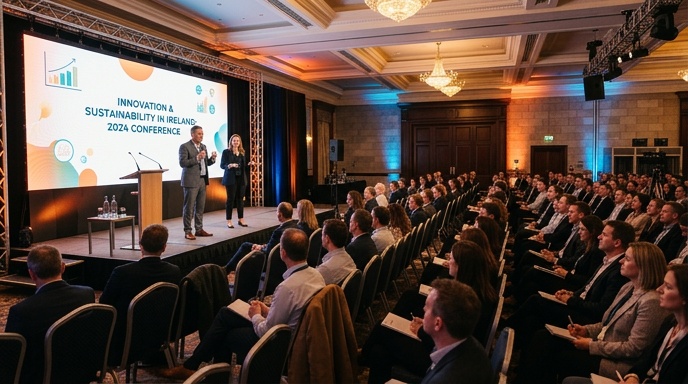
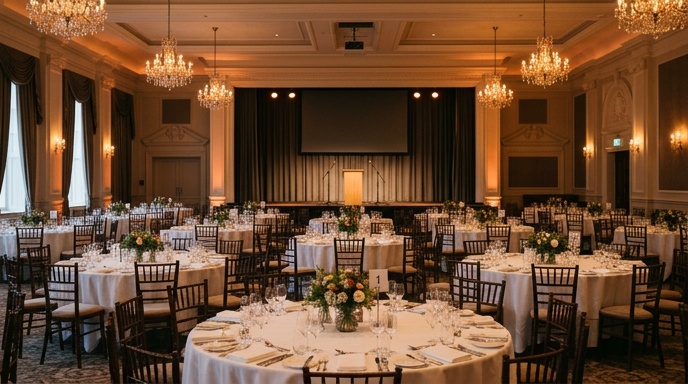
A hotel ballroom in Dublin, Cork or Killarney will comfortably handle a seated dinner for 200 to 400 guests. For anything bigger, or for a show-style format with elevated production, look at arena-style venues or purpose-built event spaces. The ceiling height matters more than most planners realise, because it dictates what lighting rigs and screen sizes are possible.
Tip 2: Build a Run of Show That Respects the Room
The single biggest mistake at Irish awards nights is a bloated running order. Twenty-two categories, four speeches, a keynote and a live band all before midnight is a recipe for tired guests and a rushed finale.
A tight run of show usually looks something like this.
- Guest arrival and drinks reception, 45 to 60 minutes.
- Call to seats and welcome from the MC, 5 to 10 minutes.
- First awards block, 20 to 25 minutes covering 5 or 6 categories.
- Starter served, short break.
- Second awards block, keynote or video content between courses.
- Main course, then final awards block including the headline category.
- Dessert, closing remarks, band or DJ on.
Group categories into blocks so guests aren’t standing up and sitting down every three minutes. Keep acceptance speeches to 60 seconds and put that on the invite so people prepare accordingly.
Tip 3: Use the Big Screen as the Backbone of the Night
A large LED video wall behind the stage does more than look impressive. It becomes the storytelling engine of the whole ceremony. Winner names, sponsor logos, category graphics, shortlist reels, live camera feeds of speeches, all of it lives on that screen.
For a room of 300 to 500 guests, a screen around 6m wide by 3.5m high works well as a main backdrop. For arena-scale events, you can go significantly larger, and side screens help guests at the back of the room see acceptance speeches clearly.
- Use a fine pixel pitch (around 2.6mm to 3.9mm) for indoor events where guests sit close to the stage.
- Build category holding graphics, winner reveal animations and sponsor slots into one playback file so nothing is triggered manually mid-show.
- Include a live camera feed cut into the screen during speeches so the person at table 32 can actually see the winner’s face.
- Have a dedicated screen operator on comms with the show caller. Do not run it off a laptop on the floor.
If you’re working with a supplier, ask whether they own their LED screen rental stock directly and whether they can do install and derig on the day. Sub-contracted screens with unfamiliar operators cause most of the on-night visual problems we see.
Tip 4: Get the Audio Right or Nothing Else Matters
Guests will forgive a lot on an awards night. Bad sound is not one of those things. If the MC’s microphone crackles or the winner’s speech is inaudible at the back of the room, that’s what people remember on the drive home.
What Good Awards Ceremony Sound Looks Like
You want even coverage across every seat, no dead spots at the back, and enough headroom for the band or DJ afterwards without redesigning the system. That usually means a distributed speaker setup rather than two big stacks either side of the stage.
- Two wireless handheld mics for the MC and presenters, plus one spare on standby.
- A lectern mic if you have a keynote speaker or long address.
- A dedicated playback channel for video content and stings so audio levels stay consistent.
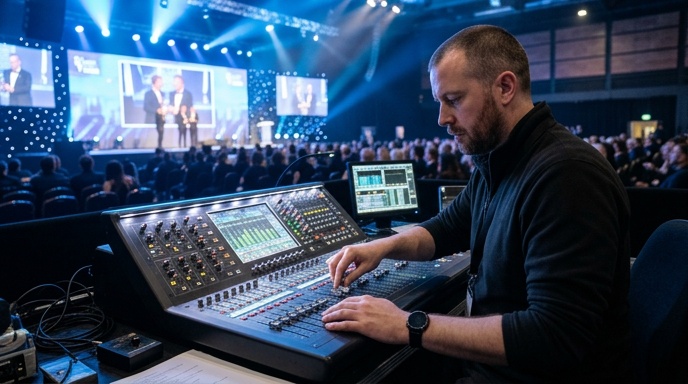
- A sound engineer at front of house, not just a self-op mixer plugged in at the back.
For hotel ballrooms with tricky acoustics, a proper site visit ahead of the event is worth its weight in gold. The room sounds very different empty versus full of 300 guests in suits.
Tip 5: Lighting Is How You Change the Energy
Lighting is the difference between an awards ceremony that feels like a school prizegiving and one that feels like a proper event. It doesn’t need to be a full concert rig, but it does need to shift with the moment.
Think about lighting in three states.
- Dinner state. Warm, dim, atmospheric. Guests can see their plates and each other, nothing more.
- Awards state. Stage brightly lit, MC and presenters clearly visible on camera, room lighting pulled down to focus attention forward.
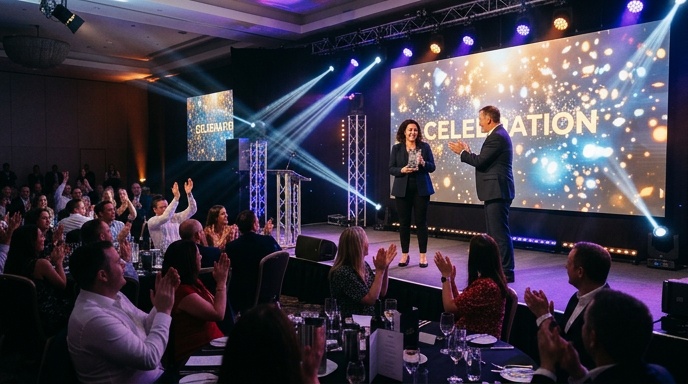
- Celebration state. Moving lights, colour washes, higher energy for the winner reveal moments and for the band or DJ later on.
Programme the lighting cues alongside the run of show so the operator can trigger each state in one hit rather than fiddling with sliders on the night. Uplighters around the perimeter of the room lift the whole space and photograph beautifully.
Tip 6: Handle the Content Before the Doors Open
Half the stress on an awards night comes from content that arrives late. Shortlist videos, sponsor slides, winner reveal graphics, thank you cards. If any of that lands on the day, you’re already behind.
Set a hard content deadline 10 working days before the event and stick to it. Build a single master playback file, run through it end to end with the client the day before, and lock it. Any changes after that point go through a formal change request, not a WhatsApp message at 5pm on show day.
- Confirm winner names in a sealed document, not verbally.
- Pre-record any video messages from absent winners or overseas sponsors.
- Have a graphics operator on standby for genuinely last-minute changes, but treat those as exceptions.
Tip 7: Entertain Sponsors and Branding Without Killing the Room
Sponsors pay the bills at most Irish awards nights, and they deserve visibility. The trick is weaving them in without making the room feel like a trade show floor.
Use the LED screen for rotating sponsor logos during dinner, dedicated sponsor stings before each category they support, and short thank-you moments from the MC. Physical branding can be limited to a step-and-repeat backdrop at the arrivals photo point and subtle table cards. Resist the urge to plaster logos on every surface. It cheapens the night and, ironically, dilutes the sponsor value.
Tip 8: Plan for the Things That Go Wrong
Something always goes sideways at a live event. A winner’s not in the room. A speech runs to seven minutes. The MC skips a category. What separates a good production team from a great one is how invisibly they handle it.
- Have a runner in the room who can locate no-show winners between courses.
- Brief the MC on soft cut-off lines for long speeches.
- Keep a spare wireless mic charged and on comms at all times.
- Have a backup laptop mirroring the master playback file, ready to switch in seconds.
- Agree a clear chain of command. Show caller talks to techs, event manager talks to venue, one person talks to the client.
For guidance on event safety planning, particularly around crowd numbers and licensed venues, the Health and Safety Authority publishes useful resources worth reviewing during the planning phase.
Book Your Suppliers Early and Together
The last practical point. If your screen, sound and lighting are coming from three different suppliers, you’re going to spend the day of the event refereeing arguments about power, rigging points and cable routes. Working with a single team who handle audio, video and lighting under one roof removes an enormous amount of friction and means the on-site crew are already used to working together.
Book at least 3 to 4 months ahead for anything happening in Q4, which is peak Irish awards season. Popular venues and quality production crews get snapped up fast.
If you’re weighing up an upcoming awards night and want a straight steer on what kit you actually need versus what you can skip, get in touch with our team for a site visit and a proper walk-through of the room.